Wednesday, November 9, 2011

Venus in Furs - Ohhhhh Yeahhhhh


New revival in NY - Why am I here??


The plays opens with a thunderclap, as Ms. Arianda’s Vanda staggers into the generic room where Mr. Dancy’s Thomas is getting ready to wrap up his day, having failed to find the actress he was hoping for. In a tempest of irritation and mortification, Vanda rails at the subway, the rain and the fates, spewing expletives about the creepy guy who was feeling her up on the train.
She is hours late and knows she’s probably blown her chances, but proceeds to cajole, apologize and charm Thomas into hearing her out, flickering between abjection and steely insistence, modes that will prove to be unusually appropriate for the role she’s come to try out for.
Ms. Arianda is the best physical comedian the stage has produced in some time, as affirmed by her physically exuberant performance in the Broadway revival of “Born Yesterday” last spring. Here her klutzy ballet of desperation as Vanda wrestles with a recalcitrant umbrella, roots around in her bag for a costume and then suddenly strips down to her saucy black lingerie, is a dazzling comic set piece.


http://video.nytimes.com/video/2011/11/08/theater/100000001156486/excerpt-venus-in-fur-on-broadway.html

Sunday, November 6, 2011

Nietzsche's Amor Fati and Becoming What One Is - Some surprising conclusions to my investigations!


Fatalistic themes recur throughout Ecce Homo. Explaining why he returned to Rome while writing Zarathustra, Nietzsche comments that “some fatality was at work” (EH III: Z-4).


He declares that “amor fati” is the mark of “greatness”: that one does not merely “bear what is necessary . . . but love[s] it” (EH II: 10). Later he remarks (not surprisingly) that “amor fati is my inmost nature” (EH III: CW-4).


The depth of Nietzsche’s fatalism regarding his own life becomes most apparent in a long passage from the second chapter of Ecce Homo. Nietzsche is here discussing his development as a philosopher, after noting that, “To become what one is, one must not have the faintest notion what one is” (EH II: 9).

Saturday, November 5, 2011

The MOST Beautiful Equation: Euler’s Identity


I am totally convinced that this is what Plato was pursuing in the Republic
where e is Euler's number, the base of natural logarithms,

i is the imaginary unit, which satisfies i2 = −1,

and π is pi, the ratio of the circumference of a circle to its diameter

Mathematics for the win!

Philosophers are guys who failed Intro to Calculus


Thursday, November 3, 2011

Marie Howe - Practicing - In the What the Living Do

In WHAT THE LIVING DO,

Marie Howe explores the emotional impact of incest and death on a woman from childhood to adulthood.
In the first section, Howe illustrates the tests that the young girl, Marie, experiences. “Sixth Grade” shows her brothers tying Marie and a friend to the garage door and torturing them with a dried deer’s leg. “Practicing” is the girls, first explorations of romance, kissing each other in the basement to get ready for the real thing. And in “The Mother,” readers see the father, drunk and abusive, forcing himself on the girl. In all, readers feel the girl’s detachment as she tries to stay outside of the pain


PRACTICING

I want to write a love poem for the girls I kissed in seventh grade,
a song for what we did on the floor in the basement
of somebody’s parents’ house, a hymn for what we didn’t say but thought:
That feels good or I like that, when we learned how to open each other’s mouths
how to move our tongues to make somebody moan. We called it practicing, and
one was the boy, and we paired off—maybe six or eight girls—and turned out
the lights and kissed and kissed until we were stoned on kisses, and lifted our
nightgowns or let the straps drop, and, Now you be the boy:
concrete floor, sleeping bag or couch, playroom, game room, train room, laundry.
Linda’s basement was like a boat with booths and portholes
instead of windows. Gloria’s father had a bar downstairs with stools that spun,
plush carpeting. We kissed each other’s throats.
We sucked each other’s breasts, and we left marks, and never spoke of it upstairs
outdoors, in daylight, not once. We did it, and it was
practicing, and slept, sprawled so our legs still locked or crossed, a hand still lost
in someone’s hair . . . and we grew up and hardly mentioned who
the first kiss really was—a girl like us, still sticky with moisturizer we’d
shared in the bathroom. I want to write a song
for that thick silence in the dark, and the first pure thrill of unreluctant desire,
just before we’d made ourselves stop.

Science, Faith and First Principles contra Goats Piggy-Backing other Goats

This is a common, recurring thought in our culture. But its very persistence can seem a bit mysterious. After all, taken one way, it is easy to answer. “Science” isn’t a name for a collection of beliefs. It names a collection of methods for acquiring beliefs — methods that involve logic, observation and experiment. It is these methods that distinguish science, not doctrine. So in that sense, science is clearly not a faith — it isn’t a religion.
Nonetheless, the thought that science may still be based on something like faith remains. And there is a reason it hangs around. Like so many nagging questions, the idea that science is not free from faith contains a grain of truth.
In an earlier post, I noted that even science has its first principles. These principles — call them epistemic principles — tell us what methods and sources to trust. They are fundamental (“first”) precisely because you can’t defend them without relying on them. (Try giving a good argument for why logic is reliable that doesn’t use logic.)


This reaction is understandable. But it rests on a mistake. It is right that we can’t give epistemic reasons — evidence — for those fundamental principles that tell us what evidence to trust. But that doesn’t mean we can’t give reasons for those principles at all. Indeed, we had better. As I argued in the first post, dogmatism, or conviction without reason, is the enemy of the democratic enterprise. But the reasons we give can’t involve further appeals to methods for belief. We can’t give epistemic reasons for epistemic first principles. We have to give reasons of a different sort.
But what sort of reasons? A number of readers of that post suggested that the methods and principles of science are superior simply because they are more useful. It is only by relying on them that we can build bridges, cure diseases and so on. And of course that is correct. But this point alone won’t answer the skeptics about reason. First, skeptics about scientific reason are rarely if ever skeptical about it across the board. Their quarrel is with its use in certain domains. They aren’t going to say that we should never use observation, logic and experiment to figure things out. What they will argue is that these methods have a lower priority in some subjects than others. In some domains, other methods — such as consultation of sacred texts — trump.
Nonetheless, appealing to the utility of science is a good start: it is the right sort of reason, even if it is, by itself, insufficient. Even if we can’t give epistemic reasons for epistemic first principles, we can give what philosophers sometimes call practical reasons for employing the methods of science, and therefore for committing to the principles that give them more weight than others.

Here’s one example of what I have in mind. Scientific principles of rationality have certain democratic virtues that many of their rivals lack. One of the virtues of scientific rationality is that it privileges principles that — as we in fact just noted — everyone appeals to most of the time — just because we are built that way. Of course the fact that people can’t help but use methods like observation and logic doesn’t prove that those methods are always more reliable than others, or even reliable at all. (Just as the fact that people thought the earth was flat doesn’t mean it was). But it does mean that principles which privilege these methods — which give them more weight than others, no matter what the question — have an obvious virtue: they recommend methods that aren’t secret or the province of a few. They recommend methods that everyone can and does use. Indeed, it is this very virtue of scientific methods that was so celebrated in the Enlightenment. Prioritizing scientific methods is liberating precisely because it frees one from appeals to authority, from the thought that something is true because some person, religious tradition, or political party, says so.
But isn’t it just a matter of opinion that scientific methods are open and democratic in this way? Do we have any real reasons — other than personal preference — for thinking this is the case? I think we do. Here’s a brief thought experiment that makes the point. Imagine playing a game the point of which is to figure out, together with other players, what epistemic principles and methods to privilege on another world (call it Parallel Earth). Principles are privileged on Parallel Earth, let’s imagine, when they are taught in the schools, used to make decisions about grants and the like. In playing the game, you know that Parallel Earth will appear to be just like our planet. And you also know you will live on Parallel Earth after the game ends. But you don’t know two important facts: when playing the game, you don’t know what social and educational position you’ll occupy on Parallel Earth. And you don’t know what methods are going to be reliable on Parallel Earth. But you have to decide which methods to privilege on Parallel Earth anyway.

So how are you going to decide? Since, in playing the game, you don’t know which methods are actually going to be reliable (or if any will be), you can’t base your decisions on which methods we think will produce the truth. That’s out of bounds as far as the game is concerned. And yet since you also don’t know your future social position, it is unlikely you’ll decide on methods that would only be available to a few, or which would allow some people to have secret knowledge that no one else could ever obtain. After all, you might not turn out to be a member of the inner circle. Given the rules, it will make sense to endorse methods that build on abilities that everyone — just by being human — can appeal to. Methods that build on common experience are by nature non-secret, open to public revision and capable of being used repeatedly. That alone gives us a practical reason to privilege them, to give them more weight — independently of the question of whether they are reliable.


Of course, it would take more work to show in detail that scientific principles and methods would turn out to have more of these democratic virtues than other, competing principles. But it seems very likely that they do. And if so, we have an objective reason for favoring scientific principles of rationality over others — a reason that could be accepted no matter what your prior epistemic commitments. The first principles of science give weight to methods like observation and experiment. Because of their open public nature, they are the sorts of principles we would commit to even were we to abstract from their truth. These are the principles we would favor in an ideal state of social and epistemic equality. As such, our faith in them — our faith in reason, as it were — is not blind. It is an expression of our commitment to democracy itself.


I was just kindding about the goats!

Wednesday, November 2, 2011

The One Right Way to Run - Guaranteed!


When you’re stalking barefoot runners, camouflage helps. “Some of them get kind of prancy when they notice you filming,” Peter Larson says. “They put on this notion of what they think barefoot running should be. It looks weird.” Larson, an evolutionary biologist at Saint Anselm College in New Hampshire who has been on the barefoot beat for two years now, is also a stickler about his timing. “You don’t want to catch them too early in a run, when they’re cold, or too late, when they’re tired.”

If everything comes together just right, you’ll be exactly where Larson was one Sunday morning in September: peeking out from behind a tree on Governors Island in New York Harbor, his digital video camera nearly invisible on an ankle-high tripod, as the Second Annual New York City Barefoot Run got under way about a quarter-mile up the road. Hundreds of runners — men and women, young and old, athletic and not so much so, natives from 11 different countries — came pattering down the asphalt straight toward his viewfinder.

http://video.nytimes.com/video/2011/11/02/magazine/100000001149415/the-lost-secret-of-running.html

About half of them were actually barefoot. The rest wore Vibram FiveFingers — a rubber foot glove with no heel cushion or arch support — or Spartacus-style sandals, or other superlight “minimalist” running shoes. Larson surreptitiously recorded them all, wondering how many (if any) had what he was looking for: the lost secret of perfect running.

It’s what Alberto Salazar, for a while the world’s dominant marathoner and now the coach of some of America’s top distance runners, describes in mythical-questing terms as the “one best way” — not the fastest, necessarily, but the best: an injury-proof, evolution-tested way to place one foot on the ground and pick it up before the other comes down. Left, right, repeat; that’s all running really is, a movement so natural that babies learn it the first time they rise to their feet. Yet sometime between childhood and adulthood — and between the dawn of our species and today — most of us lose the knack.

We were once the greatest endurance runners on earth. We didn’t have fangs, claws, strength or speed, but the springiness of our legs and our unrivaled ability to cool our bodies by sweating rather than panting enabled humans to chase prey until it dropped from heat exhaustion. Some speculate that collaboration on such hunts led to language, then shared technology. Running arguably made us the masters of the world.

So how did one of our greatest strengths become such a liability? “The data suggests up to 79 percent of all runners are injured every year,” says Stephen Messier, the director of the J. B. Snow Biomechanics Laboratory at Wake Forest University. “What’s more, those figures have been consistent since the 1970s.” Messier is currently 11 months into a study for the U.S. Army and estimates that 40 percent of his 200 subjects will be hurt within a year. “It’s become a serious public health crisis.”

Nothing seems able to check it: not cross-training, not stretching, not $400 custom-molded orthotics, not even softer surfaces. And those special running shoes everyone thinks he needs? In 40 years, no study has ever shown that they do anything to reduce injuries. On the contrary, the U.S. Army’s Public Health Command concluded in a report in 2010, drawing on three large-scale studies of thousands of military personnel, that using shoes tailored to individual foot shapes had “little influence on injuries.”

Two years ago, in my book, “Born to Run,” I suggested we don’t need smarter shoes; we need smarter feet. I’d gone into Mexico’s Copper Canyon to learn from the Tarahumara Indians, who tackle 100-mile races well into their geriatric years. I was a broken-down, middle-aged, ex-runner when I arrived. Nine months later, I was transformed. After getting rid of my cushioned shoes and adopting the Tarahumaras’ whisper-soft stride, I was able to join them for a 50-mile race through the canyons. I haven’t lost a day of running to injury since.

“Barefoot-style” shoes are now a $1.7 billion industry. But simply putting something different on your feet doesn’t make you a gliding Tarahumara. The “one best way” isn’t about footwear. It’s about form. Learn to run gently, and you can wear anything. Fail to do so, and no shoe — or lack of shoe — will make a difference.

That’s what Peter Larson discovered when he reviewed his footage after the New York City Barefoot Run. “It amazed me how many people in FiveFingers were still landing on their heels,” he says. They wanted to land lightly on their forefeet, or they wouldn’t be in FiveFingers, but there was a disconnect between their intentions and their actual movements. “Once we develop motor patterns, they’re very difficult to unlearn,” Larson explains. “Especially if you’re not sure what it’s supposed to feel like.”

The only way to halt the running-injury epidemic, it seems, is to find a simple, foolproof method to relearn what the Tarahumara never forgot. A one best way to the one best way.

Earlier this year, I may have found it. I was leafing through the back of an out-of-print book, a collection of runners’ biographies called “The Five Kings of Distance,” when I came across a three-page essay from 1908 titled “W. G. George’s Own Account From the 100-Up Exercise.” According to legend, this single drill turned a 16-year-old with almost no running experience into the foremost racer of his day.

I read George’s words: “By its constant practice and regular use alone, I have myself established many records on the running path and won more amateur track-championships than any other individual.” And it was safe, George said: the 100-Up is “incapable of harm when practiced discreetly.”

Could it be that simple? That day, I began experimenting on myself.

When I called Mark Cucuzzella to tell him about my find, he cut me off midsentence. “When can you get down here?” he demanded.

“Here” is Two River Treads, a “natural” shoe store sandwiched between Maria’s Taqueria and German Street Coffee & Candlery in Shepherdstown, W.Va., which, against all odds, Cucuzzella has turned into possibly the country’s top learning center for the reinvention of running.

“What if people found out running can be totally fun no matter what kind of injuries they’ve had?” Cucuzzella said when I visited him last summer. “What if they could see — ” he jerked a thumb back toward his chest — “Exhibit A?”

Cucuzzella is a physician, a professor at West Virginia University’s Department of Family Medicine and an Air Force Reserve flight surgeon. Despite the demands of family life and multiple jobs, he still managed enough early-morning miles in his early 30s to routinely run marathons at a 5:30-per-mile pace. But he constantly battled injuries; at age 34, severe degenerative arthritis led to foot surgery. If he continued to run, his surgeon warned, the arthritis and pain would return.

Cucuzzella was despondent, until he began to wonder if there was some kind of furtive, Ninja way to run, as if you were sneaking up on someone. Cucuzzella threw himself into research and came across the work of, among others, Nicholas Romanov, a sports scientist in the former Soviet Union who developed a running technique he called the Pose Method. Romanov essentially had three rules: no cushioned shoes, no pushing off from the toes and, most of all, no landing on the heel.

Once Cucuzzella got used to this new style, it felt suspiciously easy, more like playful bouncing than serious running. As a test, he entered the Marine Corps Marathon. Six months after being told he should never run again, he finished in 2:28, just four minutes off his personal best.

“It was the beginning of a new life,” Cucuzzella told me. “I couldn’t believe that after a medical education and 20 years of running, so much of what I’d been taught about the body was being turned on its head.” Two weeks before turning 40, he won the Air Force Marathon and has since completed five other marathons under 2:35. Shortly before his 45th birthday this past September, he beat men half his age to win the Air Force Marathon again. He was running more on less training than 10 years before, but “felt fantastic.”

When he tried to spread the word, however, he encountered resistance. At a Runner’s World forum I attended before the Boston Marathon in April 2010, he told the story of how he bounced back from a lifetime of injuries by learning to run barefoot and relying on his legs’ natural shock absorption. Martyn Shorten, the former director of the Nike Sports Research Lab who now conducts tests on shoes up for review in Runner’s World, followed him to the microphone. “A physician talking about biomechanics — I guess I should talk about how to perform an appendectomy,” Shorten said. He then challenged Cucuzzella’s belief that cushioned shoes do more harm than good.

No matter. Cucuzzella went home and began hosting his own conferences. Peter Larson traveled from New Hampshire for Cucuzzella’s first gathering on a snowy weekend this past January. “I was a bit curious about how many people might show up to such an event in rural West Virginia,” Larson says. “Were the panelists going to outnumber the audience?” In fact, more than 150 attendees crowded right up to the dais.

Since then, West Virginia has become a destination for a growing number of those who are serious about the grass-roots reinvention of running. Galahad Clark, a seventh-generation shoemaker who created the Vivobarefoot line, flew in from London with the British running coach Lee Saxby for a one-day meeting with Cucuzzella. International researchers like Craig Richards, from Australia, and Hiro Tanaka, chairman of Exercise Physiology at the University of Fukuoka, have also visited, as well as scientists from a dozen different American states.

“He has turned a small town in an obese state into a running-crazed bastion of health,” Larson says. “Mark’s effort in transforming Shepherdstown is a testament to what a single person can accomplish.”

Not that he has everything figured out. I was at one of Cucuzzella’s free barefoot running clinics in May when he confronted his big problem: how do you actually teach this stuff? He had about 60 of us practicing drills on a grassy playground. “Now to run,” he said, “just bend forward from the ankles.” We all looked down at our ankles.

“No, no,” Cucuzzella said. “Posture, remember? Keep your heads up.”

We lifted our heads, and most of us then forgot to lean from the ankles. At that moment, a young girl flashed past us on her way to the monkey bars. Her back was straight, her head was high and her bare feet skittered along right under her hips.

“You mean like — ” someone said, pointing after the girl.

“Right,” Cucuzzella said. “Just watch her.”

So what ruined running for the rest of us who aren’t Tarahumara or 10 years old?

Back in the ’60s, Americans “ran way more and way faster in the thinnest little shoes, and we never got hurt,” Amby Burfoot, a longtime Runner’s World editor and former Boston Marathon champion, said during a talk before the Lehigh Valley Half-Marathon I attended last year. “I never even remember talking about injuries back then,” Burfoot said. “So you’ve got to wonder what’s changed.”

Bob Anderson knows at least one thing changed, because he watched it happen. As a high-school senior in 1966, he started Distance Running News, a twice-yearly magazine whose growth was so great that Anderson dropped out of college four years later to publish it full time as Runner’s World. Around then, another fledgling operation called Blue Ribbon Sports was pioneering cushioned running shoes; it became Nike. Together, the magazine and its biggest advertiser rode the running boom — until Anderson decided to see whether the shoes really worked.

“Some consumer advocate needed to test this stuff,” Anderson told me. He hired Peter Cavanagh, of the Penn State University biomechanics lab, to stress-test new products mechanically. “We tore the shoes apart,” Anderson says. He then graded shoes on a scale from zero to five stars and listed them from worst to first.

When a few of Nike’s shoes didn’t fare so well in the 1981 reviews, the company pulled its $1 million advertising contract with Runner’s World. Nike already had started its own magazine, Running, which would publish shoe reviews and commission star writers like Ken Kesey and Hunter S. Thompson.

“Nike would never advertise with me again,” Anderson says. “That hurt us bad.” In 1985, Anderson sold Runner’s World to Rodale, which, he says, promptly abolished his grading system. Today, every shoe in Runner’s World is effectively “recommended” for one kind of runner or another. David Willey, the magazine’s current editor, says that it only tests shoes that “are worth our while.” After Nike closed its magazine, it took its advertising back to Runner’s World. (Megan Saalfeld, a Nike spokeswoman, says she was unable to find someone to comment about this episode.)

“It’s a grading system where you can only get an A,” says Anderson, who went on to become the founder and chief executive of Ujena Swimwear.

Just as the shoe reviews were changing, so were the shoes: fear, the greatest of marketing tools, entered the game. Instead of being sold as performance accessories, running shoes were rebranded as safety items, like bike helmets and smoke alarms. Consumers were told they’d get hurt, perhaps for life, if they didn’t buy the “right” shoes. It was an audacious move that flew in the face of several biological truths: humans had thrived as running animals for two million years without corrective shoes, and asphalt was no harder than the traditional hunting terrains of the African savanna.

In 1985, Benno Nigg, founder and currently co-director of the University of Calgary’s Human Performance Lab, floated the notion that impact and rear-foot motion (called pronation) were dangerous. His work helped spur an arms race of experimental technology to counter those risks with plush heels and wedged shoes. Running magazines spread the new gospel. To this day, Runner’s World tells beginners that their first workout should be opening their wallets: “Go to a specialty running store . . . you’ll leave with a comfortable pair of shoes that will have you running pain- and injury-free.”

Nigg now believes mistakes were made. “Initial results were often overinterpreted and were partly responsible for a few ‘blunders’ in sport-shoe construction,” he said in a speech to the International Society of Biomechanics in 2005. The belief in the need for cushioning and pronation control, he told me, was, in retrospect, “completely wrong thinking.” His stance was seconded in June 2010, when The British Journal of Sports Medicine reported that a study of 105 women enrolled in a 13-week half-marathon training program found that every single runner who was given motion-control shoes to control excess foot pronation was injured. “You don’t need any protection at all except for cold and, like, gravel,” Nigg now says.

Of course, the only way to know what shoes have done to runners would be to travel back to a time when no one ever wore them. So that’s what one anthropologist has effectively done. In 2009, Daniel Lieberman, chairman of Harvard’s human evolutionary biology department, located a school in Kenya where no one wore shoes. Lieberman noticed something unusual: while most runners in shoes come down hard on their heels, these barefoot Kenyans tended to land softly on the balls of their feet.

Back at the lab, Lieberman found that barefoot runners land with almost zero initial impact shock. Heel-strikers, by comparison, collide with the ground with a force equal to as much as three times their body weight. “Most people today think barefoot running is dangerous and hurts, but actually you can run barefoot on the world’s hardest surfaces without the slightest discomfort and pain.”

Lieberman, who is 47 and a six-time marathoner, was so impressed by the results of his research that he began running barefoot himself. So has Irene Davis, director of Harvard Medical School’s Spaulding National Running Center. “I didn’t run myself for 30 years because of injuries,” Davis says. “I used to prescribe orthotics. Now, honest to God, I run 20 miles a week, and I haven’t had an injury since I started going barefoot.”

Last fall, at the end of a local 10-mile trail race, I surprised myself by finishing five minutes faster than I had four years ago, when I was in much better shape. I figured the result was a fluke — until it happened again. No special prep, awful travel schedule and yet a personal best in a six-mile race.

“I don’t get it,” I told Cucuzzella this past June when we went for a run together through the Shepherd University campus in Shepherdstown. “I’m four years older. I’m pretty sure I’m heavier. I’m not doing real workouts, just whatever I feel like each day. The only difference is I’ve been 100-Upping.”

It was five months since I discovered W.S. George’s “100-Up,” and I’d been doing the exercise regularly. In George’s essay, he says he invented the 100-Up in 1874, when he was an 16-year-old chemist’s apprentice in England and could train only during his lunch hour. By Year 2 of his experiment, the overworked lab assistant was the fastest amateur miler in England. By Year 5, he held world records in everything from the half-mile to 10 miles.

So is it possible that a 19th-century teenager succeeded where 21st-century technology has failed?

“Absolutely, yes,” says Steve Magness, a sports scientist who works with top Olympic prospects at Nike’s elite “Oregon Project.” He was hired by Alberto Salazar to create, essentially, a squad of anti-Salazars. Despite his domination of the marathon in the ’80s, Salazar was plagued with knee and hamstring problems. He was also a heel-striker, which he has described as “having a tire with a nail in it.” Magness’s brief is to find ways to teach Nike runners to run barefoot-style and puncture-proof their legs.

“From what you’re telling me, it sounds promising,” Magness told me. “I’d love to see it in action.”

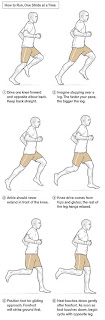
Mark Cucuzzella was just as eager. “All right,” he said in the middle of our run. “Let’s get a look at this.” I snapped a twig and dropped the halves on the ground about eight inches apart to form targets for my landings. The 100-Up consists of two parts. For the “Minor,” you stand with both feet on the targets and your arms cocked in running position. “Now raise one knee to the height of the hip,” George writes, “bring the foot back and down again to its original position, touching the line lightly with the ball of the foot, and repeat with the other leg.”

That’s all there is to it. But it’s not so easy to hit your marks 100 times in a row while maintaining balance and proper knee height. Once you can, it’s on to the Major: “The body must be balanced on the ball of the foot, the heels being clear of the ground and the head and body being tilted very slightly forward. . . . Now, spring from the toe, bringing the knee to the level of the hip. . . . Repeat with the other leg and continue raising and lowering the legs alternately. This action is exactly that of running.”

Cucuzzella didn’t like it as a teaching method — he loved it. “It makes so much physiological and anatomical sense,” he said. “The key to injury-free running is balance, elasticity, stability in midstance and cadence. You’ve got all four right there.”

Cucuzzella began trying it himself. As I watched, I recalled another lone inventor, a Czechoslovakian soldier who dreamed up a similar drill: he’d throw dirty clothes in the bathtub with soap and water, then jog on top. You can’t heel strike or overstride on slippery laundry. There’s only one way to run in a tub: the one best way.

At the 1952 Olympics, Emil Zatopek became the only runner ever to win gold medals in all three distance events: 5,000 meters, 10,000 meters and the marathon, the first he ever ran. Granted, “the Human Locomotive” wasn’t a pretty sight. During his final push to the finish line, his head would loll and his arms would grab at the air “as if he’d just been stabbed through the heart,” as one sportswriter put it.

But from the waist down, Zatopek was always quick, light and springy, like a kid swooping across a playground — or like this once-arthritic physician in front of me, laughing with excitement as he hopped up and down in his bare feet in a parking lot

Tuesday, November 1, 2011

Decoding the Brain’s Cacophony


Michael S. Gazzaniga
Michael S. Gazzaniga is a psychology professor at the University of California, Santa Barbara.


LEFT BRAIN, RIGHT BRAIN Dr. Gazzaniga with his colleagues John Sidtis and Jeffrey Holtzman, in lab coats, in the van they used at Dartmouth for studying the brain's hemispheric division of labor.

Everything was ready. The electrode was in place, threaded between the two hemispheres of a living cat’s brain; the instruments were tuned to pick up the chatter passing from one half to the other. The only thing left was to listen for that electronic whisper, the brain’s own internal code.

The amplifier hissed — the three scientists expectantly leaning closer — and out it came, loud and clear.

“We all live in a yellow submarine, yellow submarine, yellow submarine ....”

“The Beatles’ song! We somehow picked up the frequency of a radio station,” recalled Michael S. Gazzaniga, chuckling at the 45-year-old memory. “The brain’s secret code. Yeah, right!”

Dr. Gazzaniga, 71, now a professor of psychology at the University of California, Santa Barbara, is best known for a dazzling series of studies that revealed the brain’s split personality, the division of labor between its left and right hemispheres. But he is perhaps next best known for telling stories, many of them about blown experiments, dumb questions and other blunders during his nearly half-century career at the top of his field.

Now, in lectures and a new book, he is spelling out another kind of cautionary tale — a serious one, about the uses of neuroscience in society, particularly in the courtroom.

Brain science “will eventually begin to influence how the public views justice and responsibility,” Dr. Gazzaniga said at a recent conference here sponsored by the Edge Foundation.

And there is no guarantee, he added, that its influence will be a good one.

For one thing, brain-scanning technology is not ready for prime time in the legal system; it provides less information than people presume.

For another, new knowledge about neural processes is raising important questions about human responsibility. Scientists now know that the brain runs largely on autopilot; it acts first and asks questions later, often explaining behavior after the fact. So if much of behavior is automatic, then how responsible are people for their actions?

Who’s driving this submarine, anyway?

In his new book, “Who’s in Charge? Free Will and the Science of the Brain,” being published this month by HarperCollins, Dr. Gazzaniga (pronounced ga-ZAHN-a-ga) argues that the answer is hidden in plain sight. It’s a matter of knowing where to look.

The Split Brain

He began thinking seriously about the nature of responsibility only after many years of goofing off.

Mike Gazzaniga grew up in Glendale, Calif., exploring the open country east of Los Angeles and running occasional experiments in his garage, often with the help of his father, a prominent surgeon. It was fun; the experiments were real attempts to understand biochemistry; and even after joining the Alpha Delta Phi fraternity at Dartmouth (inspiration for the movie “Animal House”), he made time between parties and pranks to track who was doing what in his chosen field, brain science.

In particular, he began to follow studies at the California Institute of Technology suggesting that in animals, developing nerve cells are coded to congregate in specific areas in the brain. This work was captivating for two reasons.

First, it seemed to contradict common wisdom at the time, which held that specific brain functions like memory were widely — and uniformly — distributed in the brain, not concentrated in discrete regions.

Second, his girlfriend was due to take a summer job right there near Caltech.

He decided to write a letter to the director of the program, the eminent neurobiologist Roger Wolcott Sperry (emphasizing reason No. 1). Could Dr. Sperry use a summer intern? “He said sure,” Dr. Gazzaniga said. “I always tell students, ‘Go ahead and write directly to the person you want to study with; you just never know.’ ”

At Caltech that summer after his junior year, he glimpsed his future. He learned about so-called split-brain patients, people with severe epilepsy who had surgery cutting the connections between their left and right hemispheres. The surgery drastically reduced seizures but seemed to leave people otherwise unaffected.

Back at Dartmouth, he couldn’t stop thinking about it: Totally unaffected? Combing the literature, he found that the best attempt to detect an effect had found no changes in thinking or perception among 26 patients who had had the surgery at the University of Rochester.

Could that be possible? Mr. Gazzaniga was so eager to test the patients’ perceptions himself that he wrote another letter, this time to the surgeon — and got permission to do so.

“It’s spring break, I get all my gear together, I get all the way over there, and the guy changes his mind,” Dr. Gazzaniga said. “Like, ‘Hey, buddy, go home!’ ”

After graduating, he headed straight for Caltech.

“It wasn’t just ambition, it was something else — he was gutsy,” said Mitch Glickstein, who was in Dr. Sperry’s lab at the time and is completing a book, “Neuroscience: A Historical Introduction.” “Here’s this junior in college, he knows all about the split-brain patients, and he’s ready to do original research. At 20 years old.”

Caltech in those days was like a frat house for Nobel Prize contenders. Here’s Richard Feynman, the physicist, parking himself in the lab unannounced and making wisecracks about the experiments. There’s Dr. Sperry, annoyed, wondering how to one-up Dr. Feynman. One afternoon Dr. Sperry’s young student scrambled out into the hallway on all fours after an escaped lab animal and nearly kneecapped Linus Pauling, the eminent chemist. (“Why don’t you try anesthetizing a bowl of jelly instead?” Dr. Pauling remarked icily.)

And then there were the experiments, each one a snapshot into the dark box of the brain. In the early 1960s, Dr. Gazzaniga, then a graduate student, teamed with Dr. Sperry and Dr. Joseph Bogen, a brain surgeon, to publish a string of reports that dramatically demonstrated hemispheric specialization in humans.

The researchers devised a way to flash a picture of a bicycle to the right hemisphere alone. When split-brain patients were asked what they saw, they replied, “Nothing”: Because of the severed connection, the left hemisphere, where language is centered, got no visual input and no information from the right hemisphere. So the right hemisphere — which “saw” the bike — had no language to name it.

But here was the kicker: The right hemisphere could direct the hand it controls to draw the bicycle.

In other studies, the three scientists showed that the right hemisphere could also identify objects by touch, correctly selecting, say, a toothbrush or a spoon by feel after seeing the image of one.

The implications were soon clear. The left hemisphere was the intellectual, the wordsmith; it could be severed from the right without loss of I.Q. The right side was the artist, the visual-spatial expert.

The findings demolished the theory that specific functions were widely and uniformly supported in the brain. It also put “left brain/right brain” into the common language, as shorthand for types of skills and types of people. Still, in a field defined by incremental, often arcane advances, the Caltech team had achieved a moon shot.

Dr. Gazzaniga, now all of 25, could write his own ticket. He soon had a grant for a study to record the electronic chatter between the two hemispheres in the brain of a cat.

The Interpreter

The Beatles song that surged through the receiver in that experiment provided Dr. Gazzaniga with something almost as valuable as insight: a good story. Yet it also served as a rude reminder that he and his colleagues were missing something important in their assumptions about the brain.

“The question, ultimately, was why?” Dr. Gazzaniga said. “Why, if we have these separate systems, is it that the brain has a sense of unity?”

Even as he built his early triumph into a career, moving from Caltech to U.C. Santa Barbara and eventually to Dartmouth, with several stops along the way, the same question hung in the air, without a satisfactory answer. In the late 1970s, with the psychologist and linguist George A. Miller, he founded the field of cognitive neuroscience, a marriage of psychology and biology aimed at solving just such puzzles.

It didn’t happen, at least not quickly. In the decades to follow, brain scientists found that the left brain-right brain split is only the most obvious division of labor; in fact, the brain contains a swarm of specialized modules, each performing a special skill — calculating a distance, parsing a voice tone — and all of them running at the same time, communicating in widely distributed networks, often across hemispheres.

In short, the brain sustains a sense of unity not just in the presence of its left and right co-pilots. It does so amid a cacophony of competing voices, the neural equivalent of open outcry at the Chicago Board of Trade.

How?

It turned out, yet again, that people who’d had the split-brain surgery helped provide an answer. Dr. Gazzaniga, now at Dartmouth, performed more of his signature experiments — this time with an added twist. In one study, for instance, he and Joseph LeDoux, then a graduate student, showed a patient two pictures: The man’s left hemisphere saw a chicken claw; his right saw a snow scene. Afterward, the man chose the most appropriate matches from an array of pictures visible to both hemispheres. He chose a chicken to go with the claw, and a shovel to go with the snow. So far, so good.

But then Dr. Gazzaniga asked him why he chose those items — and struck gold. The man had a ready answer for one choice: The chicken goes with the claw. His left hemisphere had seen the claw, after all. Yet it had not seen the picture of the snow, only the shovel. Looking down at the picture of the shovel, the man said, “And you need a shovel to clean out the chicken shed.”

The left hemisphere was just concocting an explanation, Dr. Gazzaniga said. In studies in the 1980s and ’90s, he and others showed that the pattern was consistent: The left hemisphere takes what information it has and delivers a coherent tale to conscious awareness. It happens continually in daily life, and most everyone has caught himself or herself in the act — overhearing a fragment of gossip, for instance, and filling in the blanks with assumptions.

The brain’s cacophony of competing voices feels coherent because some module or network somewhere in the left hemisphere is providing a running narration. “It only took me 25 years to ask the right question to figure it out,” Dr. Gazzaniga said.

“One of the toughest things in any science, but especially in neuroscience, is to weed out the ideas that are really pleasing but unencumbered by truth,” said Thomas Carew, former president of the Society for Neuroscience and dean of the New York University School of Arts and Sciences. “Mike Gazzaniga is one of those in the field who’s been able to do that.”

Dr. Gazzaniga decided to call the left-brain narrating system “the interpreter.” The storyteller found the storyteller.

Emergent Properties

Knowing the breed well, he also understood its power. The interpreter creates the illusion of a meaningful script, as well as a coherent self. Working on the fly, it furiously reconstructs not only what happened but why, inserting motives here, intentions there — based on limited, sometimes flawed information.

One implication of this is a familiar staple of psychotherapy and literature: We are not who we think we are. We narrate our lives, shading every last detail, and even changing the script retrospectively, depending on the event, most of the time subconsciously. The storyteller never stops, except perhaps during deep sleep.

But another implication has to do with responsibility. If our sense of control is built on an unreliable account from automatic brain processes, how much control do we really have? Are there thresholds of responsibility, for instance, that can be determined by studying neural circuits? Dr. Gazzaniga and his wife, Charlotte, raised six children, so like any parents they had to determine levels of responsibility on the fly, just to get someone to set the table.

Yet questions like these became increasingly difficult to ignore for Dr. Gazzaniga, as he took on a more prominent role advising policy makers on the applications of brain science. He was appointed to a Congressional technology panel in 1991; in 2002, he took a position on the President’s Council on Bioethics. And in 2007, he became the founding director of the John D. and Catherine T. MacArthur Foundation’s Research Network on Law and Neuroscience, which tracks and evaluates applications in the legal system.

There, in particular, brain science has had a growing impact. In recent years lawyers have begun to present brain images as evidence, usually to mitigate responsibility for a crime or to test veracity of testimony, as in a polygraph; increasingly, those images have been admitted. And more are coming: In imaging studies, for instance, neuroscientists have identified cortical areas that are highly active when people suppress impulses or other behaviors.

But there are clear shortcomings in the application of each of these methods in courtrooms. Brain images are snapshots, for one thing; they capture a brain state at only one moment in time and say nothing about its function before or after. For another, the images vary widely among people with healthy brains — that is, a “high” level of activity in one person may be normal in another. Can brain science tell exactly where automatic processes end and self-directed “responsible” ones end?

Not now and not likely ever, Dr. Gazzaniga argues in his book. Social constructs like good judgment and free will are even further removed, and trying to define them in terms of biological processes is, in the end, a fool’s game.

“My contention is that, ultimately, responsibility is a contract between two people rather than a property of the brain, and determinism has no meaning in this context,” he writes in “Who’s in Charge?”

Like generosity and pettiness, like love and suspiciousness, responsibility is what he calls a “strongly emergent” property — a property that, though derived from biological mechanisms, is fundamentally distinct and obeys different laws, as do ice and water.

Dr. Gazzaniga is not the first scientist making this case. It is far from a settled matter, in part because researchers do not yet have a complete picture of how automatic and deliberate systems interact biologically.

“I see Gazzaniga’s point, and it would indeed be easiest if we could ignore conclusions derived from brain science and psychology when it comes to legal issues,” said Ap Dijksterhuis, a psychologist at Radboud University Nijmegen, in the Netherlands, in an e-mail. “However, I do not think we can do this forever, and at some point, some key legal concepts such as accountability or responsibility will have to be redefined.”

Until then, Dr. Gazzaniga’s advice is to look for them where they’ve always been: in the hearts and moral intuitions of human beings, in their laws and customs.